
A goal used to arrive on your phone ten seconds after the neighbours already screamed about it through the wall. That gap felt normal for years, a quiet tax on watching football away from the stadium. Then encoding pipelines got leaner, CDNs got smarter about routing, and the delay between kickoff on the pitch and kickoff on the screen started collapsing toward real time.
The shift matters most for anyone who treats a match as a live event rather than a recorded one. Betting markets move in the same second a penalty is awarded, and platforms built around that immediacy, including sites like slimking casino, depend on the broadcast and the odds board staying in lockstep. When the video lags behind the action by even a second or two, the whole experience of following a match alongside a wager starts to feel disjointed, like watching a dubbed film where the mouths move out of sync with the words.
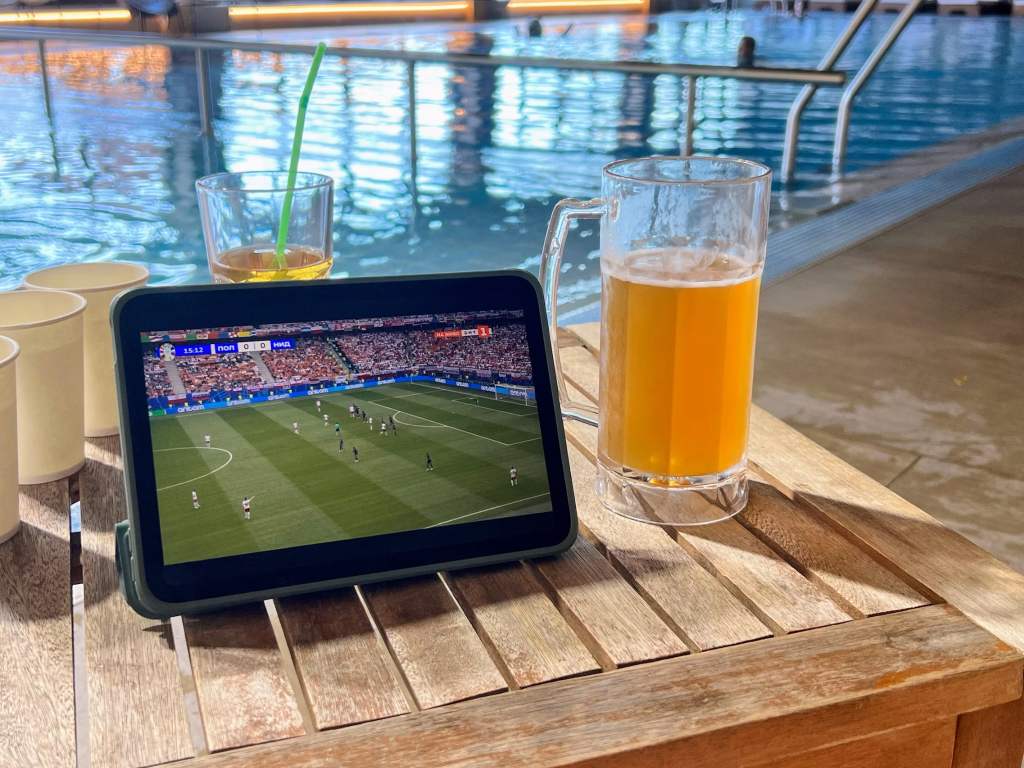
What Latency Actually Measures
Latency in streaming is the time between a moment happening in front of a camera and that same moment appearing on a viewer’s screen. It is not the same as buffering, which is a stall caused by insufficient data arriving in time. A stream can have zero buffering and still carry eight seconds of latency – smooth playback, just delayed playback. Traditional broadcast television, delivered over cable or satellite, typically sits four to six seconds behind live action. Internet streaming historically ran worse, often twenty to thirty seconds behind, because of how video gets chopped into segments before it travels across networks.
Why Segments Cause Delay
Most internet video uses adaptive bitrate streaming. The source feed gets sliced into short chunks – historically six or ten seconds each – so a device can request the next chunk at whatever quality its connection supports. That slicing made streaming reliable on shaky home internet, but each chunk had to be fully created before anyone could watch it, and older players waited for several chunks to buffer before starting playback at all.
The Engineering Behind the Half-Second Mark
Getting from twenty seconds down to under one required changes at nearly every stage of the pipeline, not a single clever trick.
- Shorter segment sizes – chunks shrank from six-second blocks down to fractions of a second using chunked transfer encoding, letting players start rendering video before a full segment even finishes encoding.
- Edge encoding – processing moved physically closer to the camera feed and closer to viewers, cutting the distance data has to travel twice.
- Smarter buffering logic – players now hold barely more video in reserve than the network’s actual jitter requires, instead of padding with several extra seconds out of caution.
- Protocol upgrades – newer low-latency variants of HLS and DASH, plus WebRTC for the most demanding cases, replaced older protocols never designed with real-time delivery in mind.
Each of these shaves off a slice of the delay. Stacked together, they turn a once-sluggish medium into something that tracks live action almost frame for frame.
How the Numbers Stack Up
| Delivery method | Typical latency | Common use case |
| Traditional cable broadcast | 4-6 seconds | National TV sports coverage |
| Standard internet streaming (older HLS) | 20-30 seconds | Early streaming platforms |
| Low-latency HLS/DASH | 2-5 seconds | Modern streaming apps |
| WebRTC-based delivery | Under 1 second | Interactive live betting, auctions |
The jump from the second row to the fourth row is the one reshaping how people experience local matches, particularly lower-tier leagues that never got a cable broadcast deal in the first place.
Why Local and Regional Sports Benefit Most
National broadcasters have spent decades optimizing their pipelines because the audiences justified the investment. Regional leagues, amateur circuits, and smaller competitions were stuck with whatever generic streaming infrastructure was cheapest, which usually meant the worst latency.
Smaller Broadcasters Catching Up
Low-latency tools built for massive platforms have trickled down and become affordable for smaller broadcasters covering regional football, handball, or volleyball. A town’s second-division match can now stream with the same half-second delay as a Champions League fixture, because the underlying protocol stack is identical even if the production budget is tiny by comparison.
The Viewer Experience Change
Fans watching on a phone in a café no longer sit a beat behind the person next to them who has the radio on. Group chats stop lighting up with spoilers before the video catches up. Commentary, replays, and live statistics arrive close enough together that the stream feels like a single coherent broadcast rather than three separate feeds loosely stitched by timestamp.
Where This Technology Is Headed Next
Sub-second latency is not the target. Engineers building the next generation of streaming protocols are aiming for millisecond-level delays, the same amount of time it takes someone in the stadium to react. It’s the tighter window that makes multi-camera angles, second-screen graphics and crowd-reaction overlays feel natural, not gimmicky. But the engineering is not simple, though the practical effect for viewers is. A match on a phone now feels less like a recording and more like being there. But it took a decade of quiet infrastructure work to arrive at a single unremarkable half-second.