
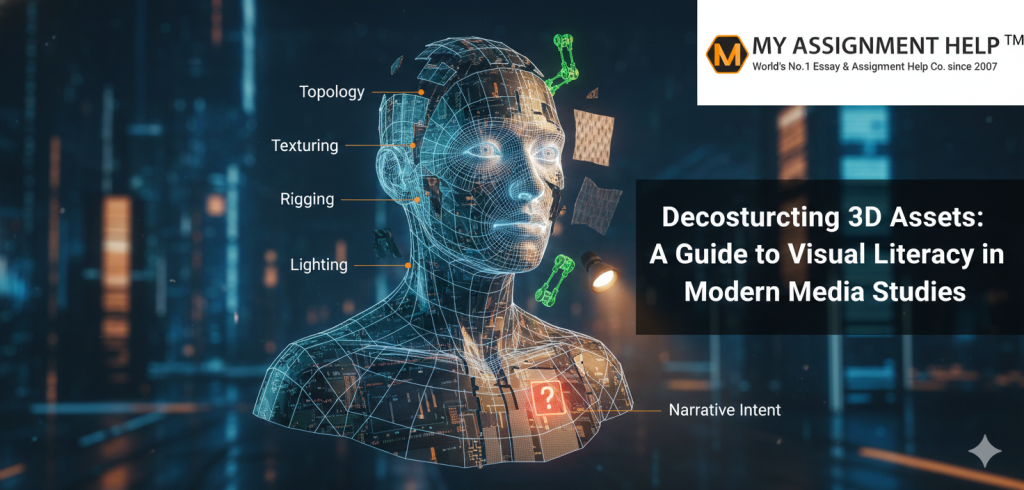
The digital landscape has undergone a tectonic shift. We no longer inhabit a world of flat images; we exist within a multi-dimensional simulation where 3D assets define our perception of reality. From the hyper-realistic textures of Cyberpunk 2077 to the surgical simulations used in medical training, 3D assets are the building blocks of modern storytelling.
However, as these assets become more sophisticated, the need for visual literacy—the ability to interpret, negotiate, and make meaning from information presented in the form of an image—has never been more critical. For students and scholars of media studies, deconstructing these assets is no longer a niche technical skill; it is a fundamental requirement for understanding 21st-century discourse.
The Anatomy of a 3D Asset: Beyond the Surface
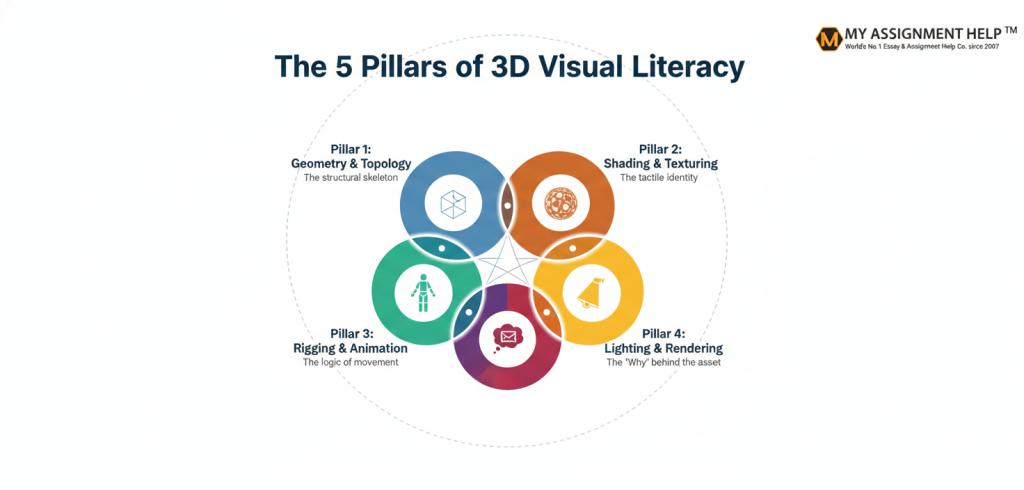
To understand a 3D asset, one must look past the “skin.” In media studies, deconstruction begins with the topology—the wireframe structure that dictates how an object moves and reacts. A high-poly model suggests a focus on cinematic realism, while low-poly aesthetics often signal a nostalgic or “indie” rhetorical stance.
For students grappling with these complex digital theories, the academic workload can often become overwhelming. Analyzing the semiotics of a 3D-rendered environment requires deep focus, which is why many seek professional essay help to manage their argumentative papers on digital media. By outsourcing the structural heavy lifting of an essay, students can dedicate more time to the actual visual deconstruction of the media they are studying. This balance is essential for mastering the nuances of digital aesthetics without burning out.
The Semiotics of Textures and Lighting
In 3D modeling, “Physically Based Rendering” (PBR) has changed how we perceive digital truth. By simulating how light interacts with surfaces (roughness, metallicity, and occlusion), creators can manipulate the viewer’s emotional response.
- Materiality: What does it say when a digital character has “weathered” skin? It implies a history, a narrative of struggle, all encoded in a texture map.
- Lighting (Global Illumination): Light creates “mood.” In media studies, we analyze how artificial lighting in 3D spaces mimics—or defies—natural physics to influence consumer behavior or player immersion.
As noted in our previous discussion on essay hook ideas, the “hook” of a visual narrative is often found in these minute details. Just as a compelling opening sentence grabs a reader, a perfectly rendered 3D asset serves as the visual hook that validates the entire digital experience.
Data-Driven Insights: The Rise of the 3D Economy
The importance of 3D literacy is backed by significant market shifts. According to Grand View Research, the global 3D rendering and virtualization market is expected to grow at a compound annual growth rate (CAGR) of 20.3% through 2030.
| Industry | 3D Usage Trend | Impact on Media Studies |
| Gaming | 90% of AAA titles use PBR workflows | Shift toward photorealism and “Deep Media” |
| E-commerce | 3D product previews increase conversion by 40% | Commercialization of the “Virtual Object” |
| Education | VR/AR adoption up by 35% in US Universities | Need for critical analysis of “Simulated Truth” |
Why Visual Literacy Matters for the Future
The “Deepfake” era is upon us. As 3D assets become indistinguishable from reality, the “uncanny valley” is shrinking. Media studies students must act as the vanguard of digital ethics. If we cannot deconstruct how an asset is built, we cannot identify when it is being used to manipulate public opinion or distort historical facts.
Deconstructing 3D assets allows us to see the “ghost in the machine”—the biases of the creator, the limitations of the software, and the cultural tropes embedded in the code.
Key Takeaways
- 3D Assets are Rhetorical Tools: They are not just “art”; they are arguments made of code and geometry.
- Topology Matters: The technical structure of a model dictates its narrative flexibility.
- Market Growth: The 3D industry is expanding rapidly, making visual literacy a high-demand career skill.
- Critical Thinking: Deconstruction is the only defense against digital misinformation in the metaverse.
FAQ Section
Q1: What is the most important element of 3D deconstruction?
The most important element is context. Understanding why an asset was created (for a game, a film, or an ad) tells you more about its design than the software used to build it.
Q2: How does 3D literacy differ from traditional art appreciation?
Traditional art appreciation focuses on the finished work. 3D literacy requires an understanding of the process—optimization, polygons, and shaders—to understand the final message.
Q3: Is the “Uncanny Valley” still relevant?
Yes. While we are approaching photorealism, the subtle “wrongness” in 3D human movement (rigging) is still a primary focus for media critics.
About the Author: Sarah Jenkins
Sarah Jenkins is a Senior Academic Consultant at MyAssignmentHelp. With a Master’s degree in Digital Media from NYU and over eight years of experience in technical writing, Sarah specializes in bridging the gap between complex digital technologies and academic theory. She has helped thousands of students navigate the evolving landscape of Media Studies through her deep-dive blogs and personalized mentoring.